
Key Takeaways
- Sensei John introduces foundational ninth kyu Shotokan karate covering warm-ups, basic kihon, and stance work.
- The instructor emphasizes core engagement during straight punching: “Remember to have the center of your body tight, your abs.”
- Technical instruction covers downward blocks, rising blocks, knife-hand techniques, and precise transitions between zenkutsu dachi and kokutsu dachi.
Foundations of the ninth kyu curriculum
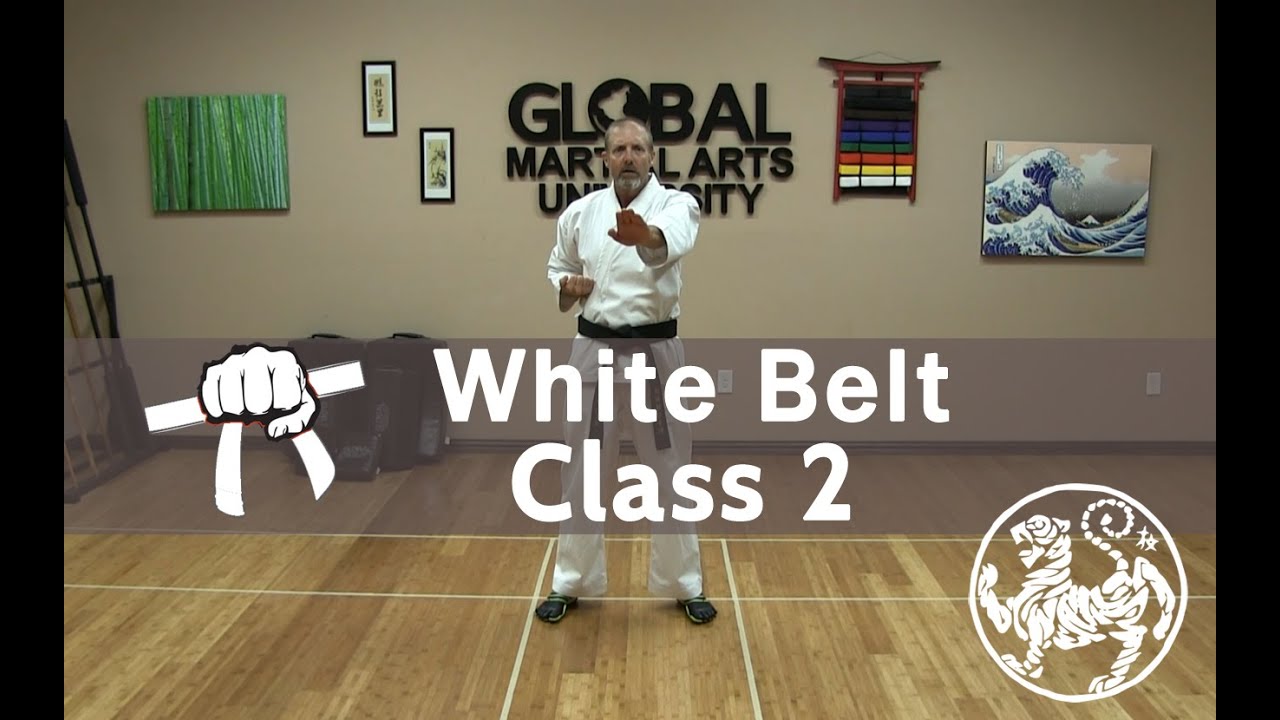
In a structured instructional session presented by the Global Martial Arts University, instructor Hodge-Sensei guides ninth kyu white belt practitioners through fundamental kihon techniques, stances, and body mechanics. Introducing the training, the instructor said, “I’m Sensei John and this is an introductory ninth KU white belt class.” The session builds systematically from functional warm-ups to stationary strikes and complex stepping patterns.
The routine opens with conditioning designed to elevate the heart rate and loosen the joints before technical execution begins. Sensei John introduces basic stride punches, explaining that “we’re punching and jogging at the same time.” The conditioning also incorporates front leg swings and front snap kicks, known as mae geri keage. Demonstrating the kick from zenkutsu dachi, he explained, “Now, what I’m doing is I’m striking with the ball of my foot where I’m going to have my foot extended here.”
Core activation and straight punch mechanics
The technical kihon portion begins with choku-zuki, the basic straight punch. Sensei John breaks down the mechanics into distinct phases before moving into full speed, placing strong emphasis on midsection stability and controlled respiration. Reminding students to remain disciplined during repetitions, he said, “Remember to have the center of your body tight, your abs.”
Expanding on breathing during punching drills, the instructor detailed his internal method for power generation. “I use a little bit of a forced breathing technique and I try to feel it from the lower part of my abdomen into my solar plexus here and visualize that energy coming out through my hand into the target,” he explained to students.
Deflection dynamics in downward and rising blocks
The class transitions into defensive techniques, starting with gedan barai. Rather than viewing the downward block as a static collision, the instructor describes it as a dynamic redirection of incoming force. Demonstrating the finish, he pointed out that “there’s that snap at the end and get on body.” He added, “So, we’re doing a receive and a redirect of whatever strike or whatever’s coming at us.”
Upper-body mechanics receive similar scrutiny during age uke practice. When executing the rising block from shizentai, Sensei John emphasized the subtle articulation required to deflect a strike effectively. “Remember, there’s a little twist, a little turn right here at the top where I’m deflecting that object and concentrating on my energy,” he noted.
Stepping drills and back stance alignment
The session advances into multi-step coordination, moving practitioners from a three-step transition down to single-step execution in zenkutsu dachi. Later in the class, Sensei John introduces shuto uke in renoji dachi before breaking down kokutsu dachi. For the knife-hand block, he detailed his base, stating, “I usually in this stance I put about 80% of my weight on my back leg.”
When demonstrating the geometry of kokutsu dachi, the instructor outlined the initial foot placement and body angle. “I’m going to put my foot at 90 degrees to the direction of my movement,” he explained while guiding students through step-by-step stance transitions. Sensei John concluded the session by cycling through single-step movements in the back stance before finishing with traditional bow etiquette.