
Key Takeaways
- Seniors at an Optum community center in Mesa began an adaptive Shotokan karate program in April, advancing to yellow and orange belts.
- Instructor Ilana Obrand, who has practiced karate since age 4 and competed internationally, modified training for older adults despite initial skepticism: “People thought I was nuts for wanting to start this program.”
- Student Jeanne Young, 70, lost nearly 10 pounds through 3-day-a-week practice and credited the training: “It really helped my mind and my strength, and my balance, I love it so much.”
New martial arts journey begins at an Arizona community center
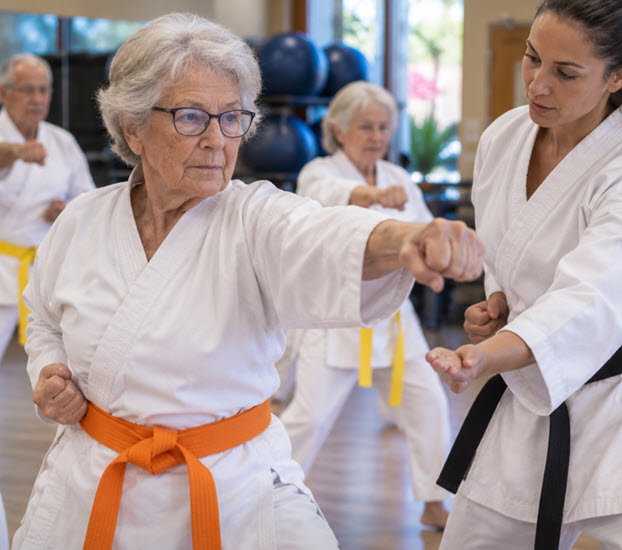
A group of seniors in Arizona is discovering martial arts late in life, proving that balance, strength and discipline have no age limit. Practicing at an Optum community center in Mesa, the participants began an adaptive Shotokan karate program in April, learning the fundamentals of striking, blocking and body control. By late September, their dedication resulted in their first formal belt tests, where every participating senior successfully advanced in rank.
Among the dedicated students are 80-year-old Claire Charles and 70-year-old Jeanne Young, both of whom had never trained in martial arts before joining the class. When asked whether she had ever engaged in combat before taking up the discipline, Charles responded with a laugh, “Uh, verbally!”
For Young, entering a martial arts dojo caught her relatives completely off guard. “My family is so surprised when I tell them I’m doing karate, ‘You?’ And I say yeah!” Young said, reflecting on their disbelief.
Building strength, balance and focus in everyday life
Rather than treating the sessions as a casual pastime, participants have embraced the physical and mental rigors of training multiple times per week. The routine has already produced noticeable changes in fitness and daily vitality for those attending regularly.
“It really helped my mind and my strength, and my balance, I love it so much, since it started, now we do three days a week. I don’t believe I’ve missed one day,” said Young, who also noted that she has shed nearly 10 pounds since taking up Shotokan in the spring. Those functional physical benefits have carried directly into her chores at home. “I feel stronger, and I have to do a lot of stuff around the house attacking our trees and doing gardening, and attacking the branches I go rawr!”
Adaptive training tailored by an international competitor
The program is led by Ilana Obrand, a fitness specialist at the Mesa community center who has trained in karate since she was 4 years old and previously competed on the international stage. Obrand adapted traditional Shotokan karate to accommodate older adults, focusing on punching, blocking and kicking to develop coordination, mental resilience, flexibility, stress relief and self-defense skills.
Launching the initiative initially raised eyebrows among those unfamiliar with adaptive martial arts. “People thought I was nuts for wanting to start this program,” Obrand admitted.
While adaptive sparring is integrated into the curriculum, live sparring rounds have not yet begun. When contact practice is introduced, participant safety and fall prevention will serve as the guiding principles. “Slower movements, just having more control so they focus on the balance aspect, of the sparing because I don’t want to see anybody falling over,” Obrand explained.
The cohort reached an important milestone on Thursday when every student who tested graduated to a yellow belt. Young performed exceptionally well during the evaluation, bypassing yellow entirely to be awarded an orange belt.